US National Climate Assessment
The US National Climate Assessment is a climate report. Many different climate reports or assessments exist, generally produced by governments or think tanks. The Intergovernmental Panel on Climate Change, IPCC, produces probably the most famous reports. IPCC is run via the United Nations, with all member nations given the ability to contribute through sending scientists to help write the technical report and government representatives given a chance to edit the summary for policymakers.
The US National Climate Assessment released most recently is the fifth one, often abbreviated NCA5. It is produced by the US Global Change Research Program (USGCRP), and was released in 2023. The creation of the USGCRP occurred due to the Global Change Research Act of 1990, which mandates that they deliver a report to Congress and the President not less frequently than every four years that “integrates, evaluates, and interprets the findings of the Program and discusses the scientific uncertainties associated with such findings; analyzes the effects of global change on the natural environment, agriculture, energy production and use, land and water resources, transportation, human health and welfare, human social systems, and biological diversity; and analyzes current trends in global change, both human-induced and natural, and projects major trends for the subsequent 25 to 100 years.”
The second Trump administration eliminated the current funding for the USGCRP and removed the website archiving previous reports, globalchange[.]gov. The work to create the sixth report, scheduled to be released in 2027, had begun, but the scientists involved were told they were no longer needed. This event prompted me to start reading the report. I was pleasantly surprised by how readable this report is, as my main experience of a climate report previously was the ocean chapter of the IPCC report, which is highly technical.
NCA5 has this to say about its intended audience: “The products of the US Global Change Research Program are designed to assist the Nation and the world in understanding, assessing, predicting, and responding to human-induced and natural processes of global change. National Climate Assessments synthesize scientific information and evaluate the state of the science on climate change to inform a broad audience of decision-makers across the country. These decision-makers include national, state, local, and Tribal governments, city planners, public health officials, adaptation specialists, nurses, farmers, business owners, community organizers, researchers, water utilities, ecosystem managers, educators, students, the media, and concerned individuals who need to make timely decisions about the climate impacts they are facing. National Climate Assessments make policy-neutral and policy-relevant information accessible and actionable by relying on the expert judgment of the report authors to determine what topics are included in each chapter, to describe what we know and where uncertainties remain, and to clearly communicate the risks, responses, and opportunities associated with climate change.”
I have only read the first two chapters so far, the overview and the climate trends chapter. I hope to bring highlights onto the blog, to help those with less time and energy for reading to get access to the main concepts. Here are a few figures from the overview chapter, chapter one, to show what that may be like.
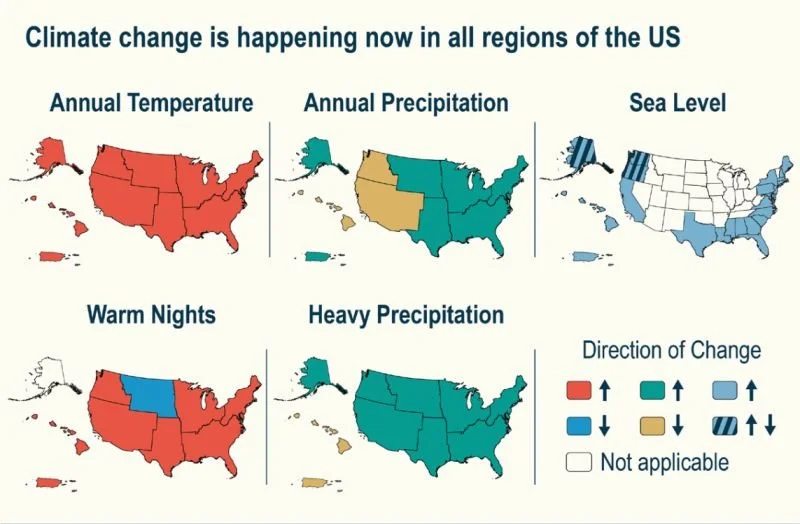
This is the top left of figure 1.1 from the US Fifth National Climate Assessment, showing some ways climate change is felt across all US regions. These include changes in temperature, precipitation, and sea level.
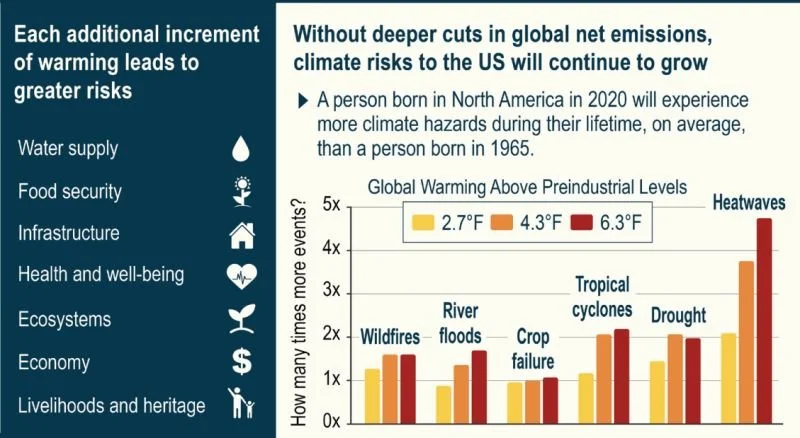
This is another piece of Figure 1.1, describing the risks associated with emissions-driven warming for people in the U.S. Those risks include food and water supply, health impacts, infrastructure damage, etc., and the risks are higher the warmer it is. Greenhouse gas emissions must be reduced to avoid further amplification of risks; it is already likely that today's children will experience more 'natural' disasters than those born in 1965. These figures were made by USGCRP/IPF and NOAA NCEI.
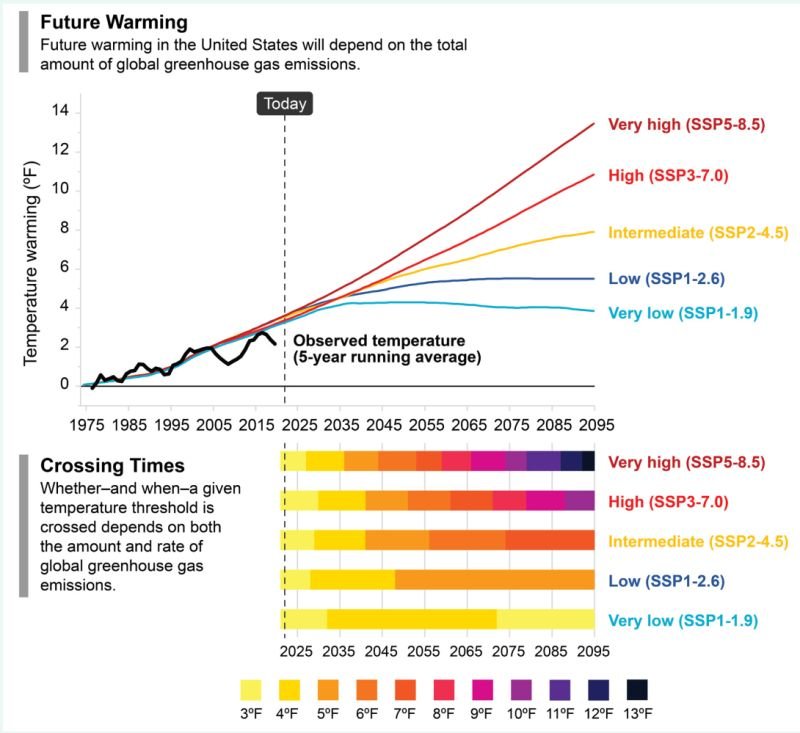
Figure 1-13, adapted from the IPCC AR6 technical summary figure 1, shows how future warming in the US depends on global greenhouse gas emissions, both via the projected temperature over time (top) and the year a warming threshold is crossed (bottom). We have locked in at least 4 degrees F of warming, but we can act to avoid a future US at 10F warmer than the 1951-1980 average.
I believe NCA5 is a great avenue to understand the effects of climate change on people here in the USA and how we can change the future. Every pound of averted greenhouse gas emissions helps us build a cooler, better future. Some trends are in the correct direction, but some are not. I hope you follow along for highlights or read the report yourself. The Internet Archive has a copy of globalchange[.]gov from before the Trump administration removed it. You can also contact me for a copy.
Another possibility is for me to create an audiobook version of the report. I’m considering making that in podcast form— let me know if you’d be interested in listening. You can email readingclimate2025[at]gmail[.]com, use the contact form, or sign up for my monthly newsletter to find out when that starts.
Official citation for NCA5: USGCRP, 2023: Fifth National Climate Assessment. Crimmins, A.R., C.W. Avery, D.R. Easterling, K.E. Kunkel, B.C. Stewart, and T.K. Maycock, Eds. U.S. Global Change Research Program, Washington, DC, USA
